
Genetics In The News
Two middle-aged women who were switched at birth did not discover the error until one of them submitted a DNA sample for an ancestry report. The Science: The sum total of all the information in your DNA is termed your “genome.” The information is derived from 3.2 billion locations in your chromosomes’ DNA. At each location one of four so-called “bases” exist. Let’s just use the base’s first letters: A,T,C and G. The bases are in fact bound to a 5-carbon sugar (deoxyribose) which in turn has a phosphorus molecule binding to it. The base, sugar and phosphate molecules comprise the to the building block of the DNA chain. The sugars are bound by a Phosphate and the bases bound to a complementary base on the other chain of the double helix. It would be to time consuming for the companies that provide DNA ancestry information to measure your entire genome. So they measure about 500,000 (500,000 of 3,200,000,000) locations from a person’s chromosomes. These are locations where variations or differences between person are most likely to reflect their heritage. There is a huge percentage of the genome that is sometimes called “junk” DNA because science has no clear idea if is used for anything. There is also a large percentage of the genome where we just do not see differences. So there is no sense measuring those areas.
How much DNA do you share with your family, cousins, etc. Remember from high school biology that you have 23 pairs of chromosomes, 46 total. With the exception of the X and Y, each of the 22 pairs each contain the same genes. but different versions of the genes. The versions are called “alleles”. At any specific location on say chromosome #2 your father’s chromosomes has the same gene as your mother’s #2, just different “alleles.” You get one allele from your mother and one from your father. In the case of the so-called sex-chromosome you get a X from your mother and either an X or a Y from you father (the boys get a Y). The X and Y are quite different. So you are literally one half of both or your parent’s genome. When it comes to those 500,000 markers the companies measure A,T, C and G’s at, you will share 50% with your parents. Fifty percent. Fifty with mom, fifty with dad. That makes you whole. You have to because when the egg that became you was fertilized half the DNA was your mom’s and the other half from dad’s sperm (my college students squirmed when I said “dad’s sperm). The companies use fancy terms for these data, terms like centimorgans. Don’t worry about the fancy terms.
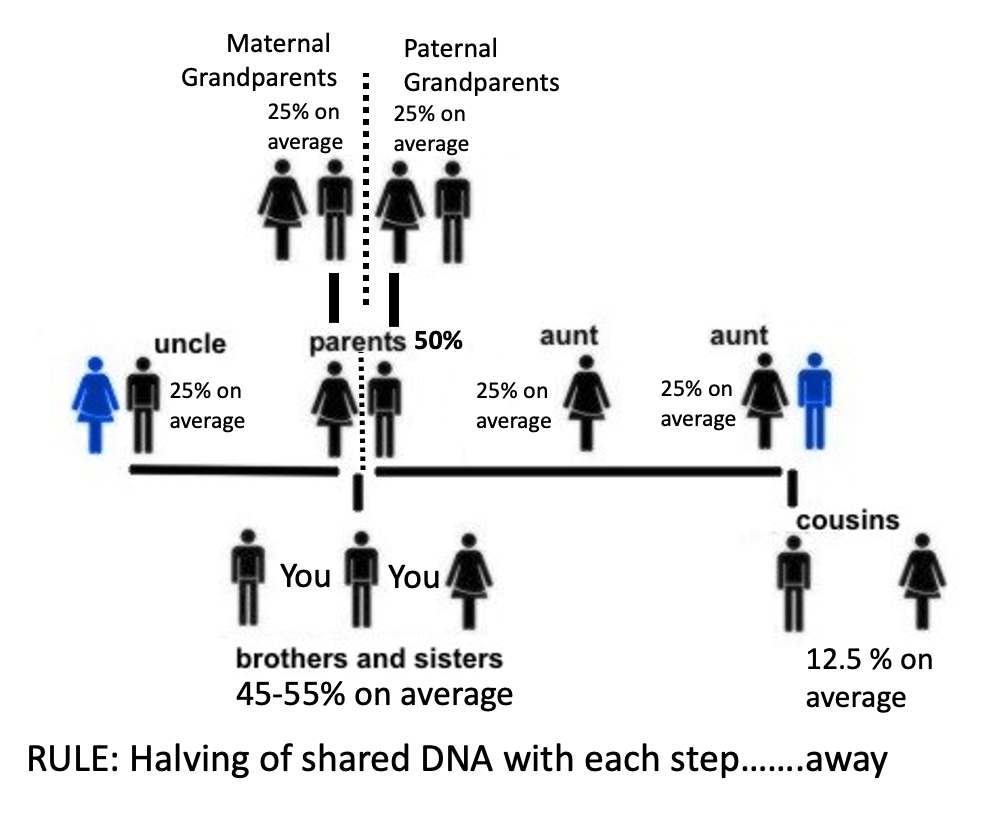
Brothers and sister. Since you siblings also got their chromosomes from your parents, brothers and sisters AVERAGE 50% of the same DNA (measured as A,T, C and G’s at specific locations in genome). AVERAGE was the key term because there is variation. Think about it this way. When your mother produced the egg that would become half of you, the process of putting one each of the two “homologous” chromosomes (e.g., chromosome #5) is random. (Note: persons that aced college biology might remember “crossing over”; which means that during your mother or father’s meiosis segments of Granma’s and Grampa’s chromosomes can be swapped; but it does not change the math). One of chromosome #5 came from your maternal grandmother and one from your maternal grandfather. Which one ends up in any egg is RANDOM. This is why you were taught Punnett Squares in Biology. Thus it is theoretically possible (although extraordinarily highly unlikely) that you and a sibling got the same set of 23 chromosomes when your mother was producing an egg. The same applies to the odds of chromosomes sorting during meiosis (gamete formation) in the sperm production of your father and your paternal grandfather’s and grandmother’s chromosomes which make up your father. So the odds are you will share 50% of your DNA with your siblings but there is variation which takes on a bell-shaped curve centered at 50%. When a pair of siblings randomly share above 50%, sibling resemblance increases. Most sibling share 45-55% of their DNA as measured by the technology used for ancestral tests.
With the exception of your parents being almost exactly 50% shared DNA with you, each step away from you causes a halving of shared DNA. Your grandparents and you: 25% (two steps or 0.5 x 0.5). You and your aunts and uncles: 25% (again, 0.5 up the family tree and 0.5 lateral). Your biological aunts and uncles are your parent’s siblings so there is the second 50% reduction in shared DNA. You and your cousins: 12.5% shared DNA since they are the children of your aunts and uncles and your family DNA was diluted by the non-biological aunt or uncle (i.e. not a sibling of your parents). And so it goes, 50% reduction in shared DNA with each step away from you. But even stepping further away to second cousins etc, shared DNA at 6.25% and 3.125% is measurable and this is how ancestral DNA tree’s are constructed. It is also how DNA is used in cold case violent crime investigations. If a DNA sample shares 6% of the DNA with someone who has entered a DNA sample for family tree purposes, then that person is probably a cousin of the DNA sample.
Back to the ladies in the news. So women #1 submits a DNA sample for the fun of it. And the company finds nobody in the family she grew up in, in her family DNA tree. She might have had nieces, an uncle or aunt, a cousin who had submitted DNA for ancestral information. But it would turn out that none of them would match if she had been switched at birth. The expected “kin” just did not show up, but the people that showed up in her tree would lead her to her “biological” family tree.
.

 Science and Nature by JW Foltz
Leave a reply to Tony Cancel reply